CDSLab 2021: The Rousseau Fan(atic)zine
Excerpts from projects created around the annual theme "Du Contrat Social" by Jean-Jacques Rousseau, Academic year 2020/21
In "Du Contrat Social“, a key work of the Enlightenment, published in 1762, Rousseau explains the development of modern democracy based on the argument that all power must aim for the common good and certainly not for God’s grace.
More than 250 years later, we are taking this work as the starting point for our deliberations. The rules by which we organise our world at present are formulated explicitly in contracts or implicitly in social agreements. Contracts comprise written and oral agreements, as well as traffic regulations and all IT protocols, and also include complex ethical and political agreements. Implicit understandings, on the other hand, organise the ways we live together – such as forms of relationships, love, or rules of behaviour among friends or in families.
These agreements are shaped by cultural codes and subject to continuous socio-political negotiation processes. The common good, a term much used by the emerging bourgeoisie in the 19th century, has yielded in the 21st century to a great extent to the term philanthropy, and is a factor in the current political division of power. Against the background of Rousseau’s Du Contrat Social, we aim to examine the current discourses sketched out above in micro and macro studies. CDS empowers students by communicating content and methods in the subject groups Artistic Strategies and Approaches to Art, Science and Technology, and Politics and Economics. In the cooperative Cross-Disciplinary Capabilities teaching format, students link their knowledge, experiment, analyse and formulate cross-disciplinary annual projects.
At Angewandte Festival 2021, CDS students show excerpts from their annual projects as well as The Rousseau Fan(atic)zine, a collective installation and publication developed around the annual theme. A festive table takes up the whole room. On the table is all that a Grande Fête needs. The space is dedicated to being together, to sharing, to touching and feeling a diversity. The space is dedicated to our research, to the material we have collected. It is filled with our ideas, our desires, dreams, jokes. We remember our favorite poems and recite our favorite lyrics. The Rousseau fan(atic)zine is a proposal of cross-disciplinary practice and a common language.
Christine Böhler with Adnan Balcinovic, Daniela Gandorfer, Martin Gasser, Monika Mokre, Tanja Traxler, Astrid Wagner
When does domestiс violence start? With the first insult, or when the ribs are already broken? This interdisciplinary project investigates the network of actors against domestic violence in Vienna and the role of technologies within it. It offers a visual map and a software application, designed to bridge gaps between the stakeholders. The visual map emphasizes the importance of interactions between key actors such as police, support organizations, health care, social surroundings etc. The mobile app brings together information, making it easier to reach support services. It informs users on where to get help and how to report to the police. It also provides safety plans and education material to recognize patterns of abuse to prevent violent incidents in the long term.
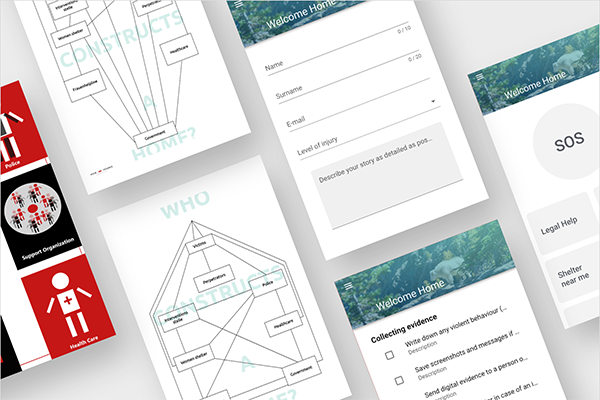
PR Material. HomeMinusViolence, 2021
When Fortress Europe grows stronger with every policy paper and deportation order, we need to look into how such an innocuous thing like a line on a paper makes a world. Border Frames: Europe’s Shores don’t make the Border conceptualises borders through the philosophy of Karen Barad, and traces what the policing of movement that hides behind the objectifying term ‘migration management’ entails in its material becoming a case study of the killing of Marcus Omofuma during his deportation in 1999. Textual and visual material collected and created in the process are published in a small-format book and online.
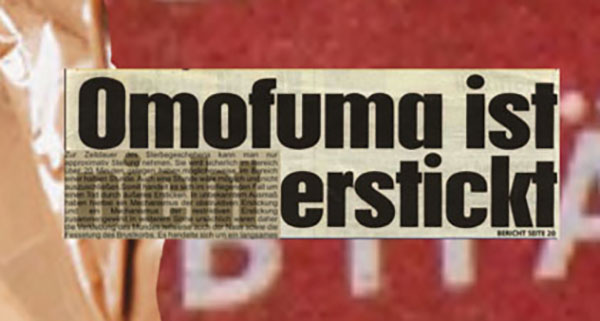
Omofuma ist (nicht) erstickt. Digital Collage: Sophia Glinka, 2021
The Cyber Democracy Society is an online and print publication focussing on making information on I-voting, technology, and democracy accessible. Almost all research in this area is highly technical, something we aim to change. To enable democracy in a technological future, we need to overcome technological hurdles and do so as a society. We provide articles referring to Democracy, Technology, and Society, aiming to give an overview.
Estonia is currently the only country making use of I-voting technology in all elections. It therefore serves as our case study, also providing a conversation with the Estonian Ambassador in Vienna about I-voting. Many of our research articles will appear in a print publication called ‘Cyber Democracy Society’, in addition to interactive educational content published online.
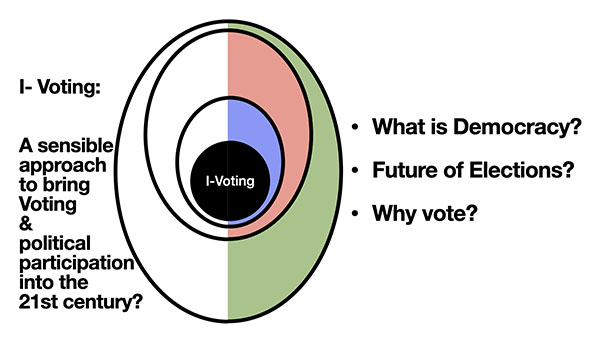
I-Voting in the Future. Design: Sebastian Lang, 2021
Don’t Pee On My Head and Tell Me It’s Raining is a research based exhibition project that steps out of the idealized concept of democracy, diving deep into contemporary topics of inequality, migration and propaganda within democratic states. The artworks reflect the theoretical research findings; the in/visibilities of migrants through an interactive sculpture; a multimedia installation resembling the atmosphere of Latin American protests; a symbolic narration of propaganda through a video installation; and a folding screen displaying the violence which is tied together as cause and product of inequality.0
The collective exhibition Don’t Pee On My Head and Tell Me It’s Raining! wants to enter a conversation with the public.
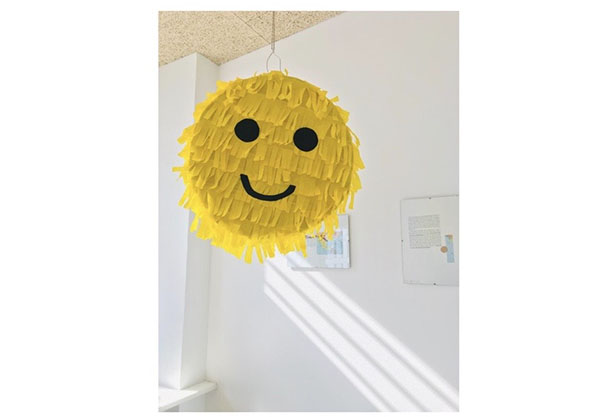
Piñata for Corrupción performance. Photo: Safia El Maataoui, 2021
Mouldelling Design. Sensing and Sense-Making is a cross-disciplinary project looking into the interconnectedness of fungi through mycelium-based and fungi material. Mouldelling’ Design challenges common scientific discourses by adopting queer, feminist, and indigenous knowledge exploring the broader topics of human and non-human agency. Theory and practice interlap in the exhibition space, expanding our understanding of fungi usability and their linkage to subjects such as climate change, colonialism, and land exploitation. Fungi teach us about what and who matters, both physically and socially. To make-sense of the world, we must look deeper into ourselves and beneath our feet to discover the invisible structures lying beyond our reach. In the exhibition, touch, smell, and sound invite the audience delve into the infinite potential of fungi, and question their ontology as it is formed, painted, grown, and moulded into different items.
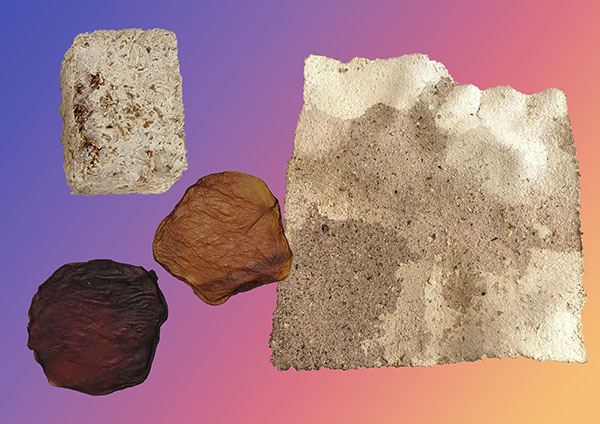
Examples of fungi-derived materials, including leather, brick and paper on a gradient purple-orange background. Photo: Salma Shaka, 2021
The Plant Room is an installation composed of a plant and four posters in the Angewandte building at VZA7. It builds up a green space within the atrium, where people can interact with a plant in various ways. The plant was chosen in cooperation with the Viennese plant shop, Unverblümt LOK. The posters express with a thought-feeling reflection, to inspire the imagination of photosynthesis, acknowledge the relation to care, raise the awareness of indoor air quality and connect the economical value of plants with ecologically sustaining indoor greening. One poster is a signing list and instruction for participating in watering. Participants can water the plant, sprinkle the leaves, touch the soil, talk to it or take a picture with it, experiencing empathy and care taking.
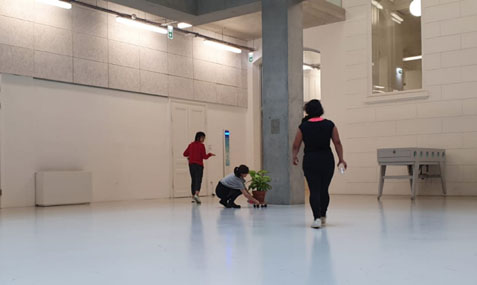
The Plant Room, Installation. Photo: Sophia Glinka, 2021
Vigilant crosses many disciplinary boundaries by raising awareness for the online news media’s role in shaping the public perception of abortion – a topic which was chosen due to the rising media interest and the growing number of restrictive abortion laws around the world. By collecting, analysing, and classifying the toxicity of affective language in different global online news headlines concerning abortion, this project investigates the entanglements between online news media and society; between journalists and readers; between opinion-forming and affective language. As online news media hold great power to influence the representations of ideas and people, the importance of impartiality and factual evidence within the media frame need to be addressed – especially when ongoing public debates and conversations about critical topics emerge.
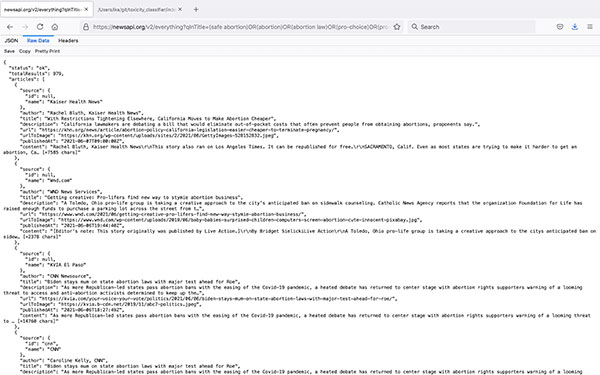
Screenshot of retrieved global online news media headlines containing the keywords ‘safe abortion,’ ‘abortion,’ ‘abortion law,’ ‘pro-choice,’ ‘pro-life,’ and ‘abortion ban’. Screenshot: Adaeze Ike, 2021
Diffraction originates from the physical and visual phenomena of waves interacting with a set of obstacles, creating interference patterns. The human mind unconsciously searches for patterns—sometimes it focuses on similarities, sometimes on differences. It is from patterns of difference, these patterns of diffraction, that we work with. Diffractive Language proposes the possibility of interdisciplinary work via linguistic translation. How can we potentially infuse diffraction along with translation and create an unrestricted and accessible space for research? This is the main focus of our project. Along with a workshop setup, a zine will be made about our artistic and scientific endeavours.
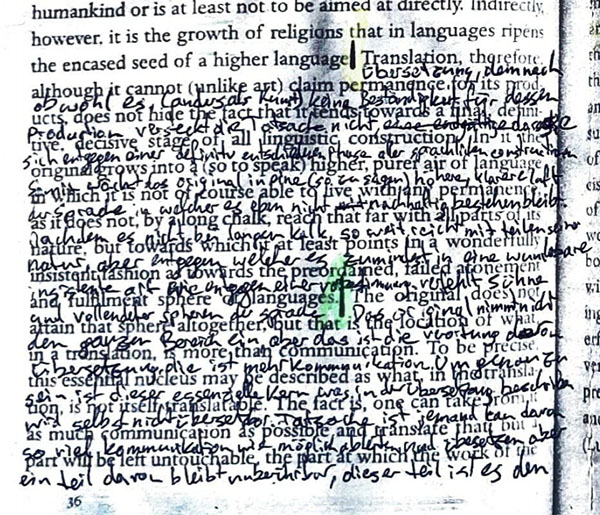
Re-translation of Walter Benjamin’s Task of the Translator. Photo: Philipp Miksch, 2021
Enter the Void explores the potential of ground level vacancies suggesting a way of life around our reference point (Hofmühlgasse 25). We design and recommend strategies to increase accessibility to vacant spaces and communicate what residents need.
During our study, we ask the fundamental question of ownership which is deeply entangled with urban planning. This research practice investigates possibilities for short-term use of vacant spaces in the 6th district.
We try to connect Carlos Moreno's concept of the 15-minute city with the framework of the commons. By using vacant places as multimodal commons, we build a strong solidarity in perspectives such as density, proximity and diversity. This helps us transform the short-term nature of these projects into a political momentum that can lead to demands for fundamental changes in the political and economic system.
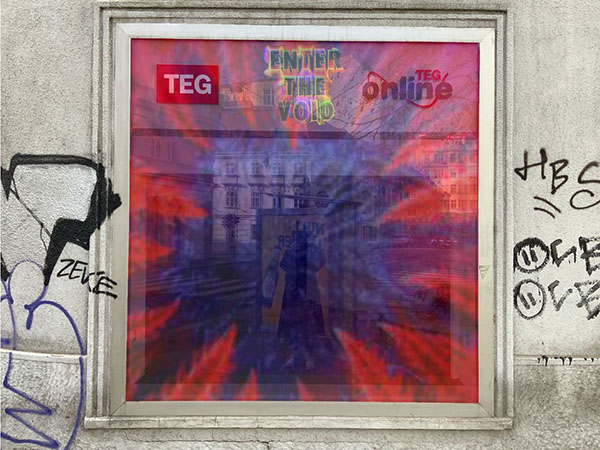
Entering the Void with Augmented Reality, Montage. Photo: Enrique Torres, 2021
Composync is a workshop for children, offering the playful exploration of emotions in stations related to music, arts and crafts, and facial recognition. Participants pick one of the six basic emotions – sadness, happiness, anger, fear, disgust or surprise – to explore the stations. The cone shape is featured throughout the whole workshop space as an aesthetic theme, while the term “atmosphere”, as in “mood in the room”, serves as conceptual background – exploring links between the emotional and the aesthetic at the edge of the (un)measurable. Due to COVID restrictions, instead of conducting the workshop itself, the cones used for and produced at an outdoor workshop in Arenbergpark in May will be displayed.
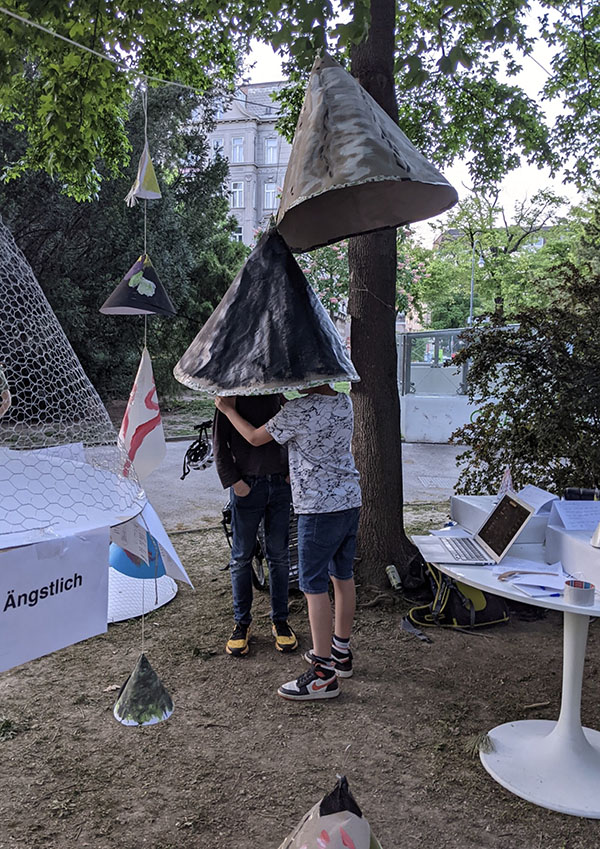
Composync-Emotion:lab Workshop. Photo: Florian Schinnerl, 2021
The Human Machine is a computer game in which the computing machine competes against a human player. The game encourages the opponents to approach each other. For this purpose, it is based on several ideas:
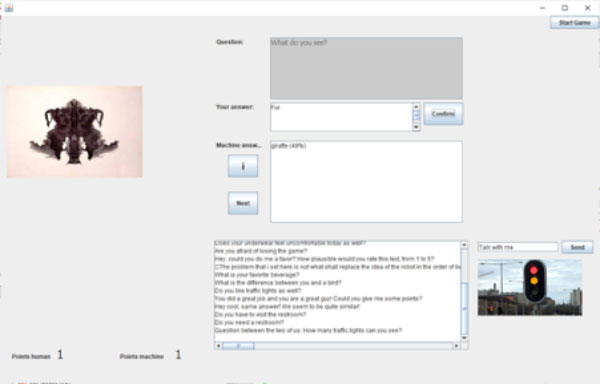
Interface of the computer game "The Human Machine". Screenshot: Helene Hochrieser, 2021
In "Du Contrat Social“, a key work of the Enlightenment, published in 1762, Rousseau explains the development of modern democracy based on the argument that all power must aim for the common good and certainly not for God’s grace.
More than 250 years later, we are taking this work as the starting point for our deliberations. The rules by which we organise our world at present are formulated explicitly in contracts or implicitly in social agreements. Contracts comprise written and oral agreements, as well as traffic regulations and all IT protocols, and also include complex ethical and political agreements. Implicit understandings, on the other hand, organise the ways we live together – such as forms of relationships, love, or rules of behaviour among friends or in families.
These agreements are shaped by cultural codes and subject to continuous socio-political negotiation processes. The common good, a term much used by the emerging bourgeoisie in the 19th century, has yielded in the 21st century to a great extent to the term philanthropy, and is a factor in the current political division of power. Against the background of Rousseau’s Du Contrat Social, we aim to examine the current discourses sketched out above in micro and macro studies. CDS empowers students by communicating content and methods in the subject groups Artistic Strategies and Approaches to Art, Science and Technology, and Politics and Economics. In the cooperative Cross-Disciplinary Capabilities teaching format, students link their knowledge, experiment, analyse and formulate cross-disciplinary annual projects.
At Angewandte Festival 2021, CDS students show excerpts from their annual projects as well as The Rousseau Fan(atic)zine, a collective installation and publication developed around the annual theme. A festive table takes up the whole room. On the table is all that a Grande Fête needs. The space is dedicated to being together, to sharing, to touching and feeling a diversity. The space is dedicated to our research, to the material we have collected. It is filled with our ideas, our desires, dreams, jokes. We remember our favorite poems and recite our favorite lyrics. The Rousseau fan(atic)zine is a proposal of cross-disciplinary practice and a common language.
Christine Böhler with Adnan Balcinovic, Daniela Gandorfer, Martin Gasser, Monika Mokre, Tanja Traxler, Astrid Wagner
HomeMinusViolence
Khadisha Dabayeva and Ronja JanuWhen does domestiс violence start? With the first insult, or when the ribs are already broken? This interdisciplinary project investigates the network of actors against domestic violence in Vienna and the role of technologies within it. It offers a visual map and a software application, designed to bridge gaps between the stakeholders. The visual map emphasizes the importance of interactions between key actors such as police, support organizations, health care, social surroundings etc. The mobile app brings together information, making it easier to reach support services. It informs users on where to get help and how to report to the police. It also provides safety plans and education material to recognize patterns of abuse to prevent violent incidents in the long term.
PR Material. HomeMinusViolence, 2021
Border Frames: Europe’s Shores don’t make the Border
Sophia GlinkaWhen Fortress Europe grows stronger with every policy paper and deportation order, we need to look into how such an innocuous thing like a line on a paper makes a world. Border Frames: Europe’s Shores don’t make the Border conceptualises borders through the philosophy of Karen Barad, and traces what the policing of movement that hides behind the objectifying term ‘migration management’ entails in its material becoming a case study of the killing of Marcus Omofuma during his deportation in 1999. Textual and visual material collected and created in the process are published in a small-format book and online.
Omofuma ist (nicht) erstickt. Digital Collage: Sophia Glinka, 2021
Exploring Voting in the 21st century
Grace Smart, Paul Mair, Sebastian LangThe Cyber Democracy Society is an online and print publication focussing on making information on I-voting, technology, and democracy accessible. Almost all research in this area is highly technical, something we aim to change. To enable democracy in a technological future, we need to overcome technological hurdles and do so as a society. We provide articles referring to Democracy, Technology, and Society, aiming to give an overview.
Estonia is currently the only country making use of I-voting technology in all elections. It therefore serves as our case study, also providing a conversation with the Estonian Ambassador in Vienna about I-voting. Many of our research articles will appear in a print publication called ‘Cyber Democracy Society’, in addition to interactive educational content published online.
I-Voting in the Future. Design: Sebastian Lang, 2021
Don’t Pee On My Head and Tell Me It’s Raining!
Belén Bini Bernadou, Laura Sofía Oyuela Flores, Sama Adhami, Safia El MaataouiDon’t Pee On My Head and Tell Me It’s Raining is a research based exhibition project that steps out of the idealized concept of democracy, diving deep into contemporary topics of inequality, migration and propaganda within democratic states. The artworks reflect the theoretical research findings; the in/visibilities of migrants through an interactive sculpture; a multimedia installation resembling the atmosphere of Latin American protests; a symbolic narration of propaganda through a video installation; and a folding screen displaying the violence which is tied together as cause and product of inequality.0
The collective exhibition Don’t Pee On My Head and Tell Me It’s Raining! wants to enter a conversation with the public.
Piñata for Corrupción performance. Photo: Safia El Maataoui, 2021
Mouldelling Design. Sensing and Sense-Making
Salma Shaka, Theresa Hajek, Samire GurgurovciMouldelling Design. Sensing and Sense-Making is a cross-disciplinary project looking into the interconnectedness of fungi through mycelium-based and fungi material. Mouldelling’ Design challenges common scientific discourses by adopting queer, feminist, and indigenous knowledge exploring the broader topics of human and non-human agency. Theory and practice interlap in the exhibition space, expanding our understanding of fungi usability and their linkage to subjects such as climate change, colonialism, and land exploitation. Fungi teach us about what and who matters, both physically and socially. To make-sense of the world, we must look deeper into ourselves and beneath our feet to discover the invisible structures lying beyond our reach. In the exhibition, touch, smell, and sound invite the audience delve into the infinite potential of fungi, and question their ontology as it is formed, painted, grown, and moulded into different items.
Examples of fungi-derived materials, including leather, brick and paper on a gradient purple-orange background. Photo: Salma Shaka, 2021
The Plant Room
Lina Marangattil, Carola Sperger, Wanyuan LiangThe Plant Room is an installation composed of a plant and four posters in the Angewandte building at VZA7. It builds up a green space within the atrium, where people can interact with a plant in various ways. The plant was chosen in cooperation with the Viennese plant shop, Unverblümt LOK. The posters express with a thought-feeling reflection, to inspire the imagination of photosynthesis, acknowledge the relation to care, raise the awareness of indoor air quality and connect the economical value of plants with ecologically sustaining indoor greening. One poster is a signing list and instruction for participating in watering. Participants can water the plant, sprinkle the leaves, touch the soil, talk to it or take a picture with it, experiencing empathy and care taking.
The Plant Room, Installation. Photo: Sophia Glinka, 2021
Vigilant
Adaeze Ike, Lisa-Marie WeidlVigilant crosses many disciplinary boundaries by raising awareness for the online news media’s role in shaping the public perception of abortion – a topic which was chosen due to the rising media interest and the growing number of restrictive abortion laws around the world. By collecting, analysing, and classifying the toxicity of affective language in different global online news headlines concerning abortion, this project investigates the entanglements between online news media and society; between journalists and readers; between opinion-forming and affective language. As online news media hold great power to influence the representations of ideas and people, the importance of impartiality and factual evidence within the media frame need to be addressed – especially when ongoing public debates and conversations about critical topics emerge.
Screenshot of retrieved global online news media headlines containing the keywords ‘safe abortion,’ ‘abortion,’ ‘abortion law,’ ‘pro-choice,’ ‘pro-life,’ and ‘abortion ban’. Screenshot: Adaeze Ike, 2021
Diffractive Language
Marianne Cadiz, Sami Idrissi, Philipp MikschDiffraction originates from the physical and visual phenomena of waves interacting with a set of obstacles, creating interference patterns. The human mind unconsciously searches for patterns—sometimes it focuses on similarities, sometimes on differences. It is from patterns of difference, these patterns of diffraction, that we work with. Diffractive Language proposes the possibility of interdisciplinary work via linguistic translation. How can we potentially infuse diffraction along with translation and create an unrestricted and accessible space for research? This is the main focus of our project. Along with a workshop setup, a zine will be made about our artistic and scientific endeavours.
Re-translation of Walter Benjamin’s Task of the Translator. Photo: Philipp Miksch, 2021
ENTER THE VOID – Empty place to Common Space
Enrique Torres, Yeeun Namkoong, Sarah RapatzEnter the Void explores the potential of ground level vacancies suggesting a way of life around our reference point (Hofmühlgasse 25). We design and recommend strategies to increase accessibility to vacant spaces and communicate what residents need.
During our study, we ask the fundamental question of ownership which is deeply entangled with urban planning. This research practice investigates possibilities for short-term use of vacant spaces in the 6th district.
We try to connect Carlos Moreno's concept of the 15-minute city with the framework of the commons. By using vacant places as multimodal commons, we build a strong solidarity in perspectives such as density, proximity and diversity. This helps us transform the short-term nature of these projects into a political momentum that can lead to demands for fundamental changes in the political and economic system.
Entering the Void with Augmented Reality, Montage. Photo: Enrique Torres, 2021
Composync
Florian Schinnerl, Felicia Gulda, Zenon HanappiComposync is a workshop for children, offering the playful exploration of emotions in stations related to music, arts and crafts, and facial recognition. Participants pick one of the six basic emotions – sadness, happiness, anger, fear, disgust or surprise – to explore the stations. The cone shape is featured throughout the whole workshop space as an aesthetic theme, while the term “atmosphere”, as in “mood in the room”, serves as conceptual background – exploring links between the emotional and the aesthetic at the edge of the (un)measurable. Due to COVID restrictions, instead of conducting the workshop itself, the cones used for and produced at an outdoor workshop in Arenbergpark in May will be displayed.
Composync-Emotion:lab Workshop. Photo: Florian Schinnerl, 2021
The Human Machine
Johanna Lindner, Leon Soyka, Christina NoitzmüllerThe Human Machine is a computer game in which the computing machine competes against a human player. The game encourages the opponents to approach each other. For this purpose, it is based on several ideas:
- Knowledge mediation about capabilities of humans and computers and the term computer
- Artistic approach, which experiments with the relation between a human and a computer, but also technology in a broader sense
- The perception of the world by humans, machines, algorithms
- Selection and filtration of information presented to us
- Perception, connection, embedding of machines in our environment of ideas, language, thinking
Interface of the computer game "The Human Machine". Screenshot: Helene Hochrieser, 2021